The signs your child needs occupational therapy usually show up in everyday tasks: holding a crayon, getting dressed, using a fork, coping with noise, or switching activities. When these stay hard for months and get in the way of home or school life, it’s time for a closer look. Pediatric occupational therapy (OT) builds the motor, sensory, and self-regulation skills behind those tasks.
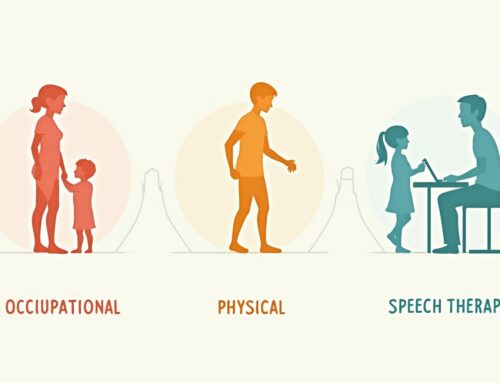
Every child struggles sometimes. The question is whether it has become a pattern. Our pediatric occupational therapy in Arizona team evaluates children whose parents, teachers, or pediatricians have noticed one. Some children also need pediatric physical therapy for balance and strength, or speech therapy for communication and feeding. Our guide to occupational therapy vs. physical therapy vs. speech therapy explains the differences.
Already concerned? You can request an OT evaluation at any point.
Key takeaways
- Signs usually show up in seven areas: fine motor skills, self-care, sensory responses, emotional regulation, executive function, school tasks, and play.
- One hard week is not a warning sign. A pattern that lasts months and affects daily life is.
- CDC milestones describe what at least 75% of children can do by a given age, so missing several is worth raising with your pediatrician.
- Children under 3 may qualify for early intervention services. Older children can receive OT in a clinic, at home, or at school.
- These signs are not a diagnosis. Only a licensed professional can evaluate your child.
What does pediatric occupational therapy help with?

Pediatric occupational therapy helps children handle the daily “occupations” of childhood: playing, learning, eating, dressing, and getting along with others. Licensed occupational therapists (OTR/L) and certified occupational therapy assistants (COTA) work on:
- Fine motor skills and handwriting readiness
- Visual-motor integration, bilateral coordination, and motor planning
- Sensory processing
- Activities of daily living (ADLs) such as dressing, grooming, and feeding
- Self-regulation, attention, and executive function
OT commonly supports children with autism spectrum disorder, ADHD, developmental coordination disorder (dyspraxia), Down syndrome, cerebral palsy, premature birth, and handwriting difficulties. Sensory processing disorder is not a separate diagnosis in the DSM-5, but occupational therapists routinely assess and treat sensory processing differences.
Developmental milestones by age
These milestones come from the CDC’s Learn the Signs. Act Early. program. Most children (75% or more) can do each one by that age.
| Age | Hand skills | Self-care |
|---|---|---|
| 2 years | Holds something in one hand while using the other | Eats with a spoon |
| 3 years | Draws a circle when shown how | Uses a fork; puts on loose pants or a jacket |
| 4 years | Holds a crayon between fingers and thumb, not in a fist | Unbuttons some buttons; pours water with supervision |
| 5 years | Writes some letters of their name | Buttons some buttons |
Wondering what age a child should hold a pencil correctly? The CDC places a finger-and-thumb grasp at 4 years, and grip keeps maturing through the early school years.
7 early signs your child may need occupational therapy

1. Fine motor skills are a struggle
Fine motor skills use the small muscles of the hands for writing, cutting, and fastening. Watch for a child who:
- Grips crayons awkwardly or tires quickly
- Struggles with child-safe scissors
- Avoids coloring, drawing, or puzzles
These are common fine motor delay signs in preschoolers. A child occupational therapist builds hand strength and dexterity through play, and can target handwriting directly when that’s the main worry.
2. Self-care routines need constant help
Signs include:
- Ongoing trouble putting on or taking off clothes
- Difficulty with spoons, forks, or open cups
- Strong resistance to toothbrushing or hair washing
- Needing help with shoes and zippers long after peers stop
Therapists break routines into small steps and practice them until your child can do more alone. OT also helps with picky eating and feeding difficulties. Read more about how pediatric OT builds independence.
3. Strong reactions to sensory input
Some children are bothered by sounds, textures, or lights. Others seek movement all day. Look for a child who:
- Covers their ears at ordinary noise
- Refuses certain fabrics or food textures
- Melts down in crowded, busy places
- Spins and crashes far more than peers and can’t settle afterward
This isn’t misbehavior. Occupational therapy for sensory processing issues in children starts with observing how your child responds, then building strategies such as a sensory diet: planned movement and calming activities spread through the day.
4. Emotions and transitions are hard to manage
Big feelings are normal. Concern grows when a child:
- Has frequent meltdowns during routines
- Takes a long time to calm down
- Reacts strongly when switching activities
These reactions look like defiance but often point to a self-regulation gap. OTs teach calming strategies and help families set up predictable routines, which makes transitions more manageable.
5. Attention and organization fall apart
Executive function is the set of skills a child uses to plan, follow directions, and finish tasks. Signs include:
- Losing track of multi-step instructions
- Forgetting what they need for school
- Needing constant reminders for familiar routines
OTs use visual schedules, checklists, and step-by-step practice to help children organize and follow through.
6. School tasks feel harder than they should
Parents and teachers may notice:
- Slow or hard-to-read handwriting
- Difficulty finishing seatwork
- Frustration with multi-step tasks
- Trouble attending during group time
Many children catch up with practice. When difficulty persists, an OT can pinpoint the underlying skill (grasp, visual-motor integration, sensory regulation, or organization) and work on it directly.
7. Play and coordination are difficult

Watch for a child who:
- Has trouble stacking blocks or fitting toys together
- Avoids puzzles, crafts, or construction toys
- Struggles to learn new movements, like climbing playground equipment
Motor planning challenges make new activities feel risky. OTs use play to build coordination one step at a time. If balance and strength are the bigger issue, a physical therapist may also help.
When does a child need occupational therapy?
Ask for an occupational therapy evaluation for children when:
- A difficulty has lasted more than a few months
- It interferes with daily life at home, at school, or in play
- Your child is falling noticeably behind peers
- A teacher, childcare provider, or pediatrician has raised a concern
Signs a toddler needs occupational therapy often show up first in feeding, play, and early self-care. If your child loses skills they once had, contact your pediatrician promptly. Skill loss at any age is a red flag.
What happens during a pediatric OT evaluation?

A pediatric OT evaluation is a play-based visit where a licensed therapist looks at how your child moves, plays, and handles daily tasks. At Theracare, it typically includes:
- Parent intake: You share concerns, history, and daily routines.
- Play-based observation:The therapist watches your child draw, build, move, and respond to sensory input.
- Standardized testing when needed: The OT may use formal motor or sensory assessments.
- Goal setting: You agree on goals that matter to your family.
- Next steps: You receive recommendations, which may include a therapy plan, home activities, or a referral to another discipline.
Ready to schedule a pediatric OT evaluation? Contact our team or learn about our Mesa clinic. If you plan to use insurance, ask your child’s primary care physician for a prescription for services first.
OT vs. physical therapy vs. speech therapy
| Comparison | Occupational therapy | Physical therapy | Speech therapy |
|---|---|---|---|
| Main focus | Daily tasks, fine motor, sensory, self-care | Walking, balance, strength | Communication, language, feeding, swallowing |
| Example goal | Buttoning a coat | Climbing stairs | Using two-word phrases |
Frequently asked questions
1. Does my child need a referral for occupational therapy?
If you plan to use insurance, yes. Theracare needs a prescription for services from your child’s primary care physician, faxed to (623) 374-4158. Private pay is considered case by case.
2. Does insurance or AHCCCS cover pediatric occupational therapy?
Coverage depends on your plan. Theracare accepts most insurance policies and works with families served by Arizona’s Division of Developmental Disabilities (DDD). AHCCCS plans may cover medically necessary therapy, so confirm your benefits with us. See our insurance page.
3. How long does pediatric occupational therapy take?

It varies by child and goal. Many children attend weekly sessions for several months while the therapist tracks progress and updates goals. Home practice helps.
4. What age can a child start OT?
OT can start in infancy. In Arizona, children from birth to age 3 may qualify for services through the Arizona Early Intervention Program (AzEIP). Older children can start whenever concerns appear.
5. What’s the difference between OT and PT?
OT focuses on daily tasks, hand skills, and sensory processing. PT focuses on walking, balance, and strength. Many children need both.
6. Can OT help children with autism or ADHD?
Yes. OT doesn’t treat the condition itself, but it helps with the sensory, motor, self-regulation, and routine challenges that often come with autism and ADHD.
7. What’s the difference between school OT and private OT?
School-based OT, provided through an IEP under IDEA or sometimes a 504 plan, focuses on what a child needs to access learning. Clinic or in-home OT can address broader goals like dressing, feeding, and bedtime. Some children receive both.
8. What can I do at home?
Try play dough for hand strength, kitchen tongs for picking up pom-poms, stickers for finger control, and a picture schedule for morning routines. These support progress but don’t replace an evaluation.
Help your child build confidence and independence
Theracare Pediatric Services has more than 250 occupational, physical, and speech therapists serving families across Arizona, from Phoenix and Mesa to rural communities. Our therapists complete quarterly training in evidence-based practice, and parents join sessions so skills carry over at home.
Looking for a pediatric occupational therapist near you? If you’ve noticed signs your child needs occupational therapy, request a pediatric OT evaluation or call (602) 875-5616.